
A.W. (Tony) Diamond is Emeritus Professor of Wildlife Ecology and Director of the Atlantic Laboratory for Avian Research, University of New Brunswick, Fredericton, New Brunswick, Canada.
Contributed by Tony Diamond, November 2025
In 1971 I was field assistant to David Lack, Director of the Edward Grey Institute of Ornithology at Oxford, studying the ecology of West Indian forest birds and based at the Mona Campus of the University of the West Indies (UWI) in Jamaica. One of my tasks was to document the habitats and feeding ‘stations’ (i.e., how high they fed, and with what methods) in Saint Lucia, in visits lasting just a few days: March 10-13, May 30-June 12, and July 30-August 6. The work was published in the Ibis international journal of ornithology in 1973, ‘Habitats and feeding stations of St Lucia forest birds’. My first visit was in March with Dr. Lack. We stayed in a hotel overlooking the harbour of Castries, which was full of boats and yachts and very picturesque. We had been booked into a single room with two beds, but Dr. Lack insisted on separate rooms, saying he slept better when alone. Perhaps he snored; I never did find out. Later we moved rooms when he discovered that a room without air conditioning was $5 cheaper. Sadly, though, these rooms were missing not just A/C, but hot water, and despite the temperature, cold showers were not appreciated.
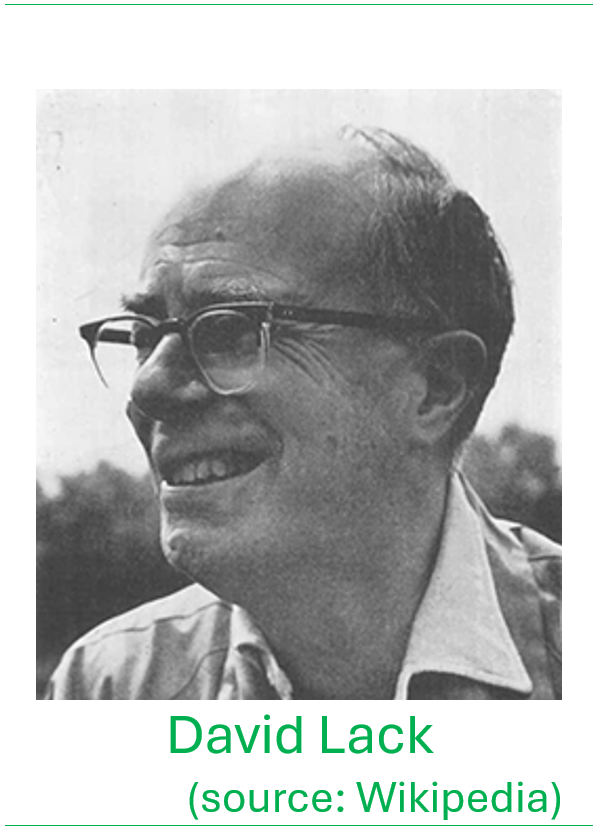
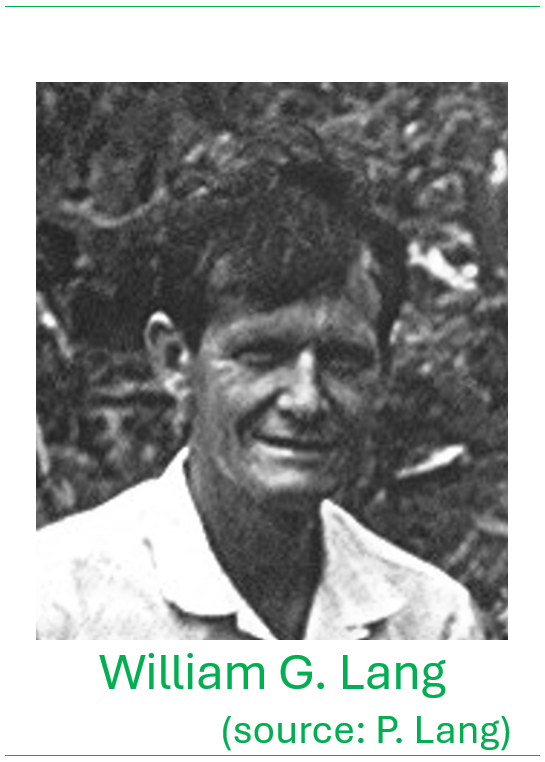
Our transport, borrowed from the Forestry Division, was an ancient Land Rover that had seen much better days (but not recently). By the way, I must acknowledge Mr. William Lang, the Forest Supervisor at the time for the loan of the Land Rover, and his help and interest throughout the study. As we eased out of their parking area, one of the forestry staff shouted an important detail “the handbrake does not work”. So here we were, about to tackle steep mountain roads with many very tight S-bends which often could not be negotiated in one go, requiring reversing mid-turn to get a better angle on the rest of the turn, in a long-wheelbase vehicle that would have to change gear several times during each manoeuvre and had no handbrake to stop the vehicle slipping backwards while the gear was being changed.
Dr. Lack, however, had a brilliant solution; he handed me the keys and slid into the passenger seat. For several days, then, it was my responsibility to ensure that one of the world’s most eminent biologists did not end his days sliding over the steep edge of a remote mountain road. He later complimented me on my driving on Saint Lucia, confessing that he knew he couldn’t have tackled those roads in that vehicle. This almost compensated for the aching ankles and feet, not to mention sweat-soaked clothing, with which I ended each day on the road.
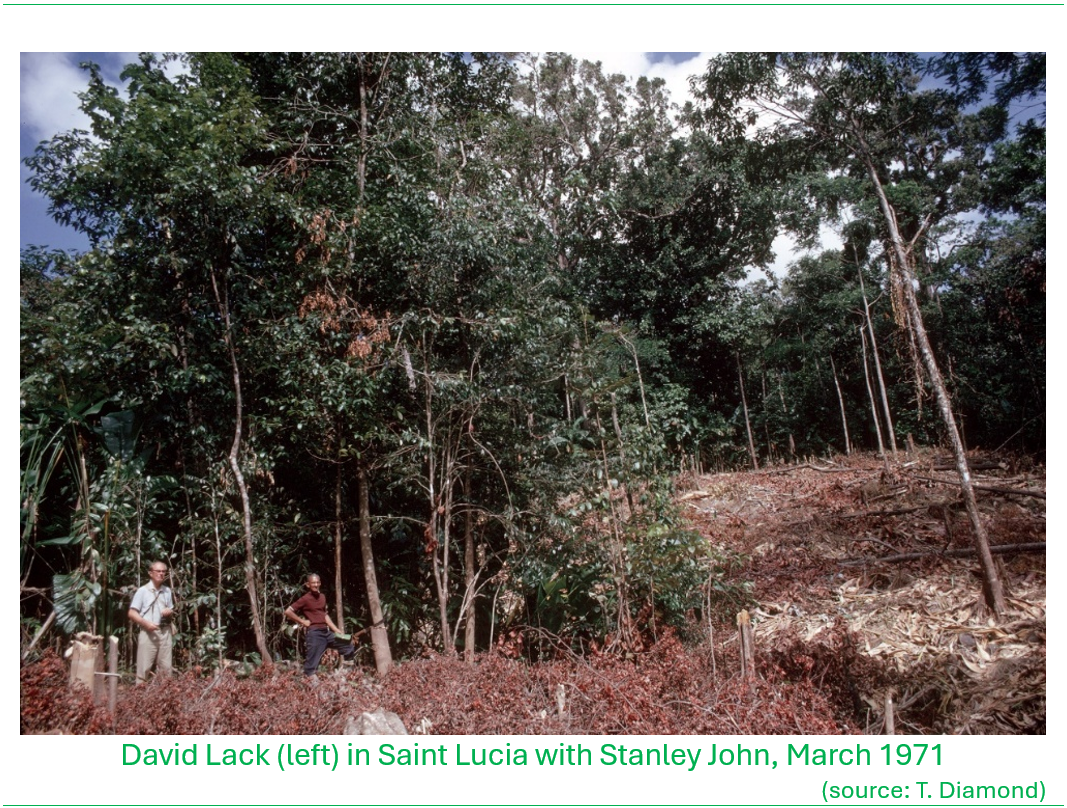
We were lucky to have the services of a legendary local bird expert, Stanley John, to spend a couple of days showing us the main types of forest and looking for the “special” species that were either endemic to Saint Lucia or in some other way important to see. Stanley was well known for his intimate knowledge of Saint Lucia’s birds, and had helped James Bond himself and other ornithologists with their field work.

Stanley was also known for being one of the very few people to have survived an attack by the notorious venomous snake, the St. Lucia Lancehead also known locally as the ‘fer-de-lance’ or ‘sepan’ which was rumoured (erroneously) to have been introduced to the island to discourage slaves from escaping. He proudly showed the scar on his leg, and said the only reason he survived was that he was wearing rubber boots at the time. Nevertheless he had had to run several miles after he had been bitten to reach medical help, so was very lucky to survive.
Stanley was brilliant at “squeaking up” birds, with a different squeak for each species; my notes describe the birds as ‘coming rushing up in hordes’. He quickly found us our first endemic species, the Saint Lucia Black Finch, which was feeding on the ground and allowed us to get very close. I was eager to see this bird because it looked so like the famous Galapagos finches about which Dr. Lack had literally written the book[1]. Males were all black, females dull brown with a grey head, both with a large deep beak and strikingly pink legs and feet. They have an explosive call quite unlike any other small bird so we could detect them by sound as well as sight as they foraged on or near the ground in wooded areas.
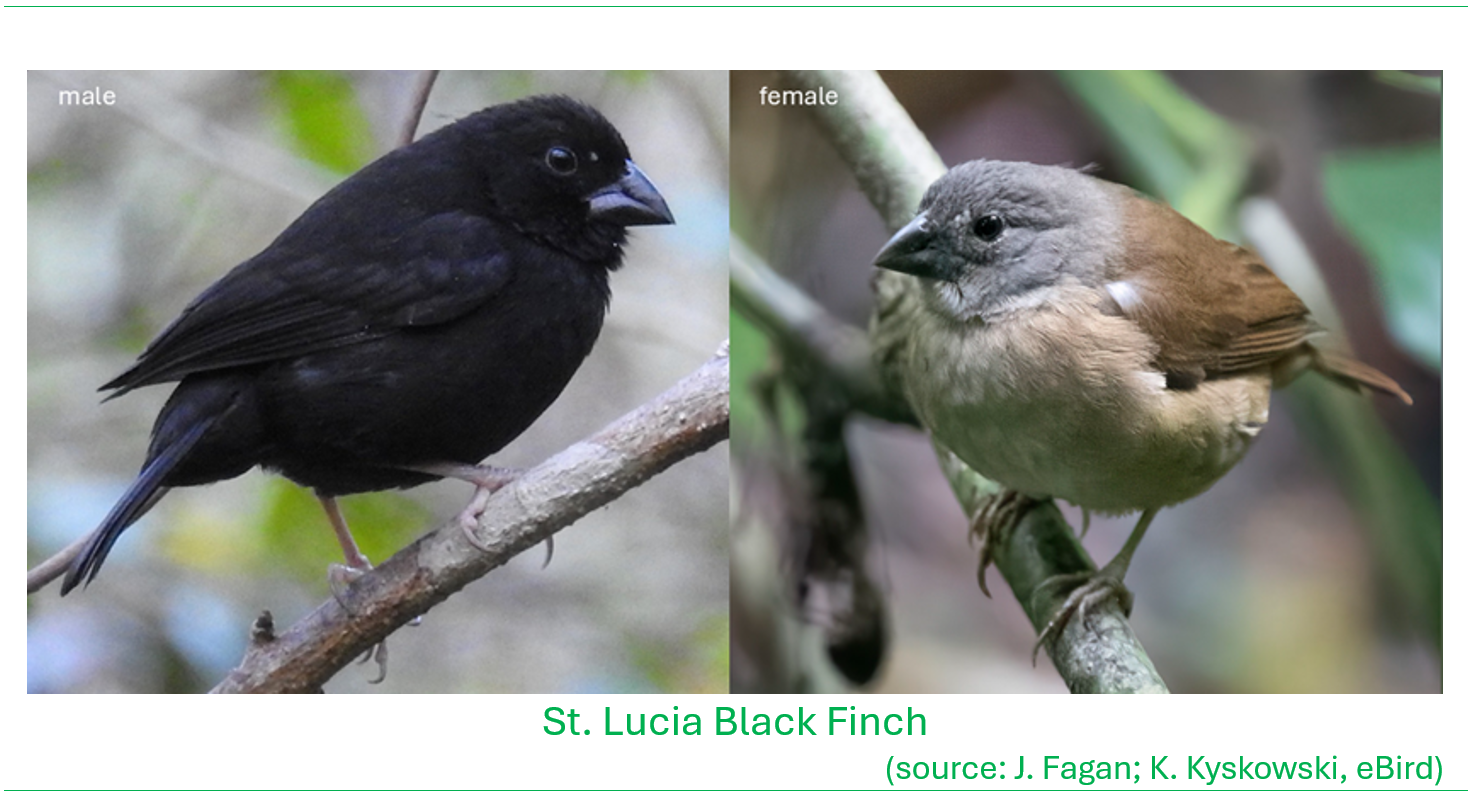
We found Black Finches in several different forest types, throughout the island, so they were not restricted to a particular habitat. Stanley could not find us the rarest of the other endemic forest birds, Semper’s Warbler. It had been seen as recently as ten years before, so we had some hope of finding one. However, Stanley had been looking for it for many years, and we did not find one; nor, at the time of writing (2025), has anybody else.
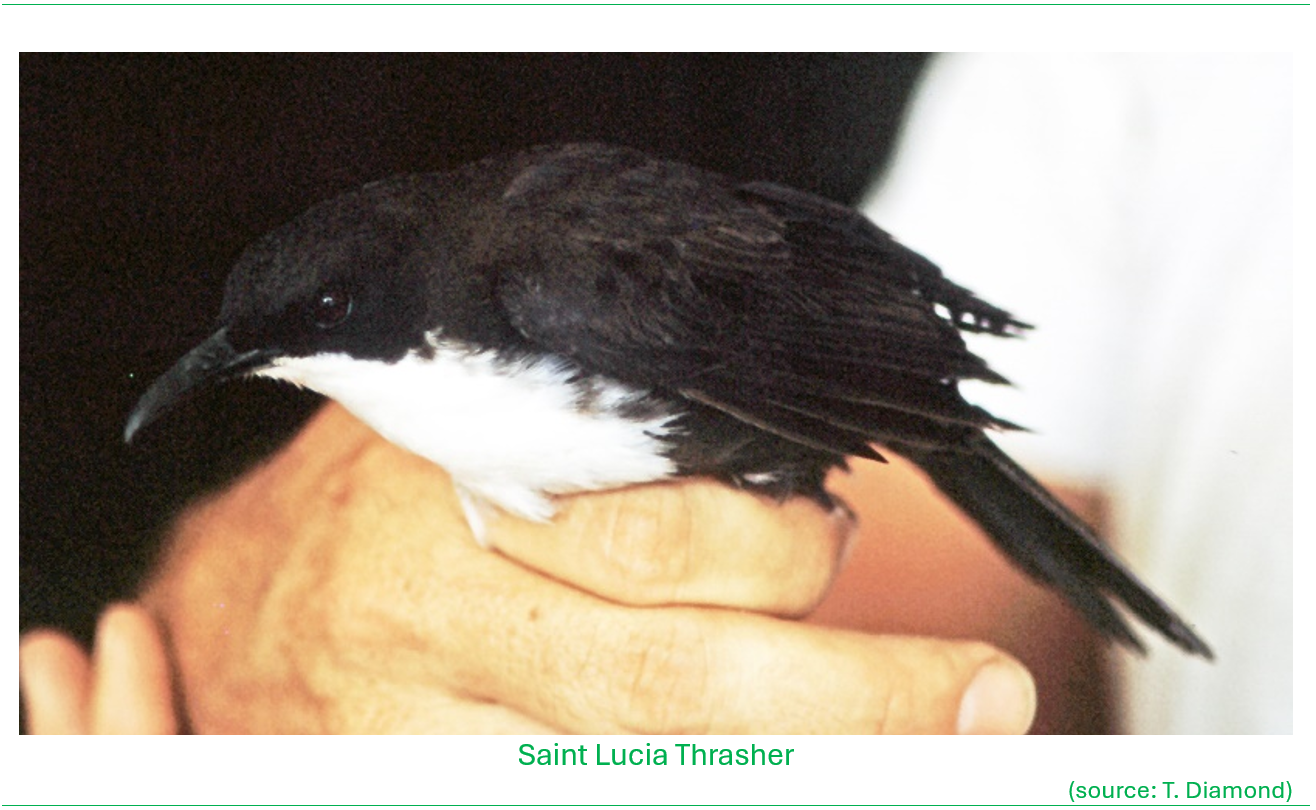
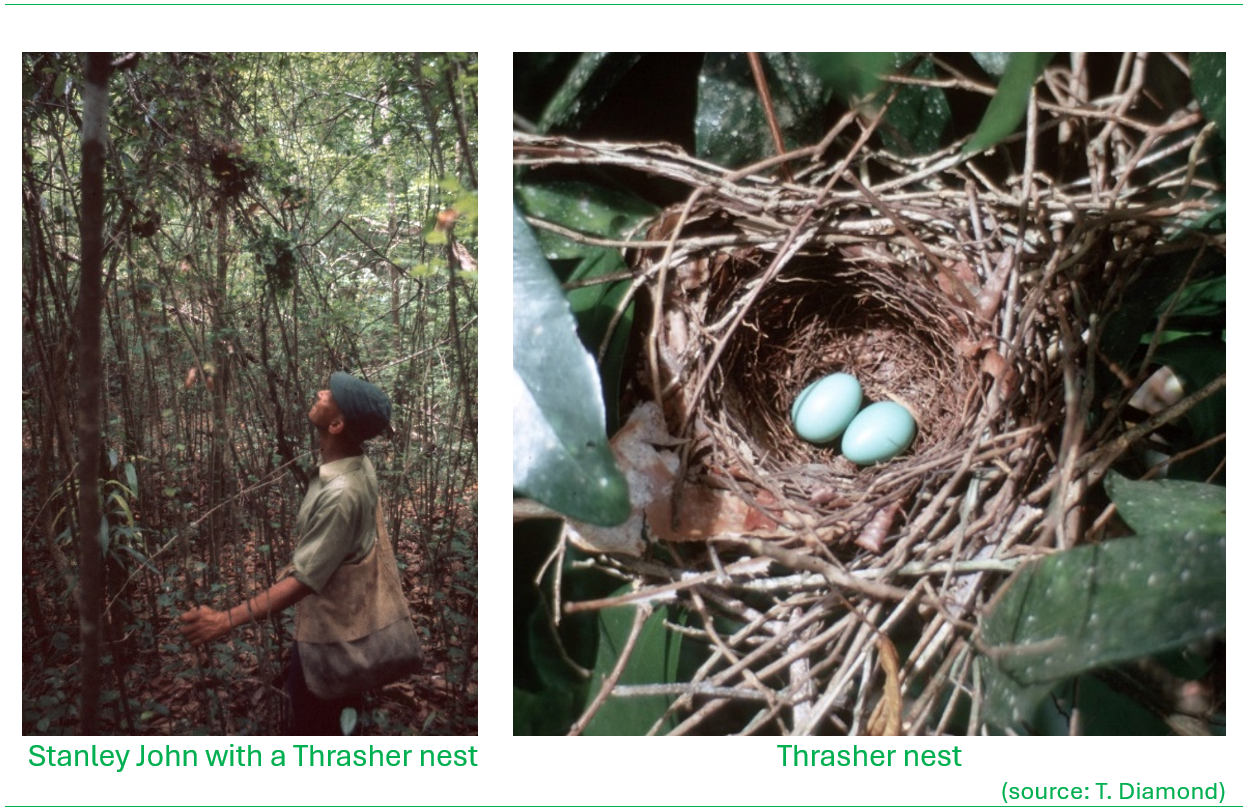
However he did lead us to several examples of another interesting species, the Saint Lucia Thrasher. Thrashers are named for their vigorous feeding behaviour, tossing leaves around in their search for juicy invertebrates among leaves on the ground. This is a striking bird, the size of a large thrush, sooty brown above and immaculate white below, with a long tail and long strong down-curved bill which it uses to forage noisily in the leaf-litter. These thrashers, like the Black Finch, also allowed quite a close approach, and during our visit Stanley showed us several nests, each with two bright-blue eggs.
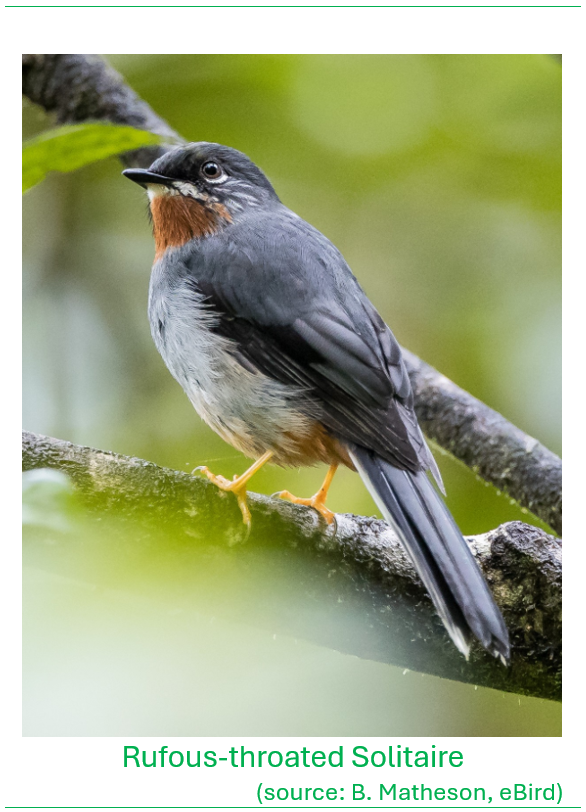
Stanley took us to humid mountain forest inland from the south-west coastal town of Soufrière, where abundant tree-ferns and palms lent an appropriately exotic look to the landscape. In addition to close-up views of the Black Finch, we were treated to the haunting song of the Rufous-throated Solitaire, a different subspecies to the version we knew in Jamaica, and to my ears even more beautiful.
On a later visit to Saint Lucia on my own, I met a young American, Jim Gulledge, who had recently finished a master’s degree and was now studying these thrashers, and especially their behaviour and voices for his Ph.D.[2] My mist-nets were useful in catching several for him to take back to New York to study in captivity. Sadly, he never published his thesis work, but he went on to be Director of the Library of Natural Sounds (now part of the Macauley Library and including visual records) at Cornell University and had a huge influence on the science of recording natural sounds.

We did not see the endemic Saint Lucia Parrot, but learned that most of the remaining individuals were being kept by people as pets. So proud were Saint Lucians of their national bird, that everyone wanted to keep one at home. Perhaps as a result, there were very few left in the wild, along with habitat loss, as a major contributor.
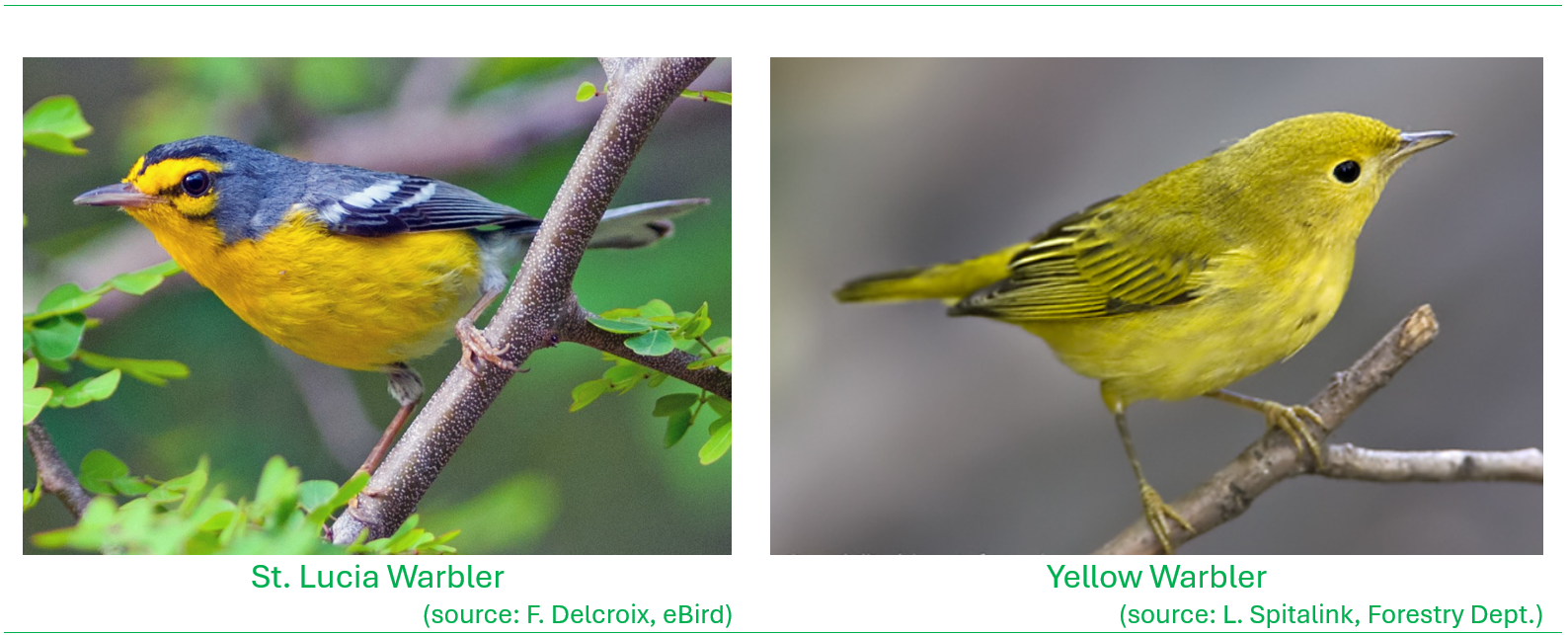
One of the most interesting songbirds to me was the Saint Lucia Warbler, then considered an endemic subspecies (delicata) of Adelaide’s Warbler (Setophaga adelaidae) with other subspecies on Barbuda (subita) and Puerto Rico (adelaidae), but now recognised as a full species confined to Saint Lucia. It was one of the most widespread and abundant songbirds in 1971, occurring in all forest habitats except the most arid scrub where it was replaced by Yellow Warblers (S. petechia). The other representatives of ‘Adelaide’s’ Warbler (as it then was) on Barbuda and Puerto Rico lived in arid habitats, and on Barbuda at least (where there is no truly humid forest) they coexisted with Yellow Warblers in a way they did not on Saint Lucia. I took this as evidence that the Saint Lucia Warbler, despite its smaller size, excluded the Yellow Warbler from moist forests on Saint Lucia.
I enjoyed my time on Saint Lucia immensely and have only good memories of the island and its people. My later visits to the Caribbean were focused on Barbuda, its ‘Adelaide’ Warblers and the frigatebird colony, where I worked in 1972 and again, with graduate students, in the mid-2000s (in my headshot photo above, I am holding the Barbuda Warbler; photo by Graham Forbes). I regret not having been back to Saint Lucia and – who knows?! – I may yet.
[1] D. Lack, 1947. Darwin’s Finches.
[2] J.L. Gulledge, 1974. A study of the phonetic and phylogenetic relationships among the mockingbirds, thrashers and their allies. Ph.D. thesis, City University of New York.

Would love to hear from you! Leave your comments below!